Click Here to see shocking
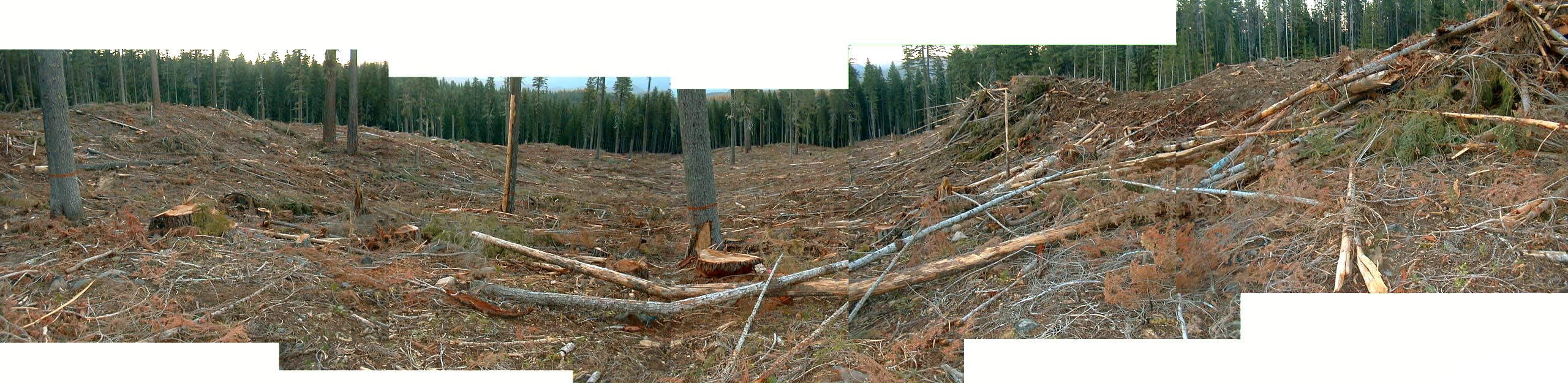
pictures of Ancient Forests and Clearcuts, including
heartbreaking "Before and After"!
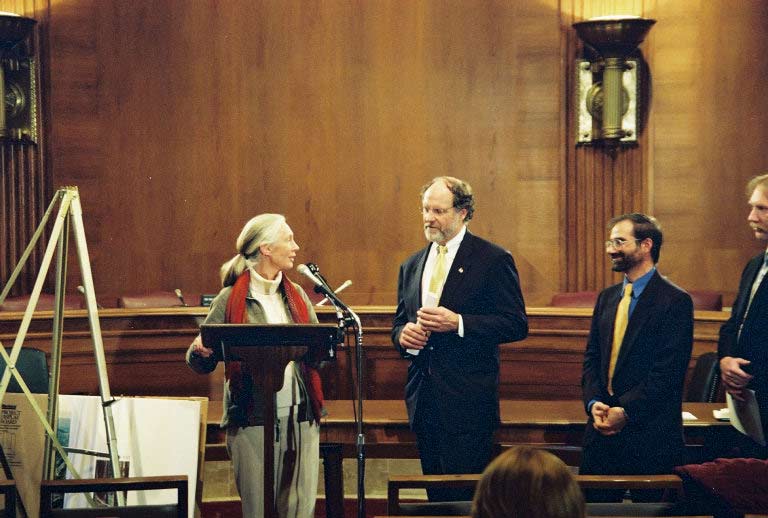
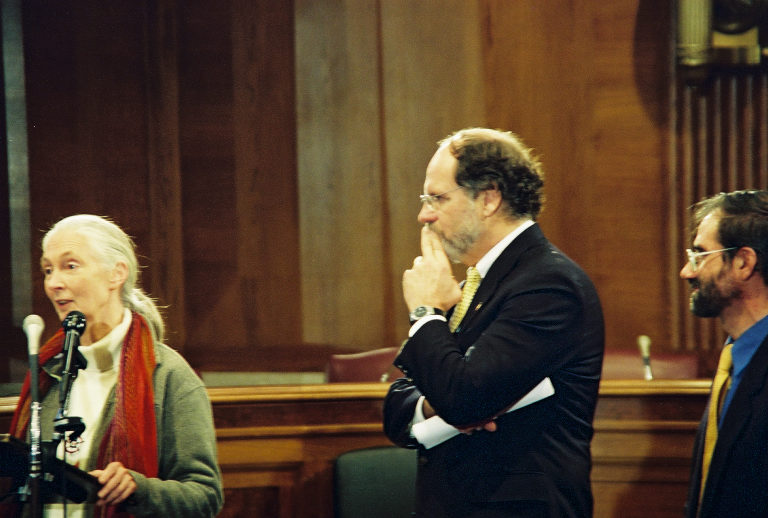
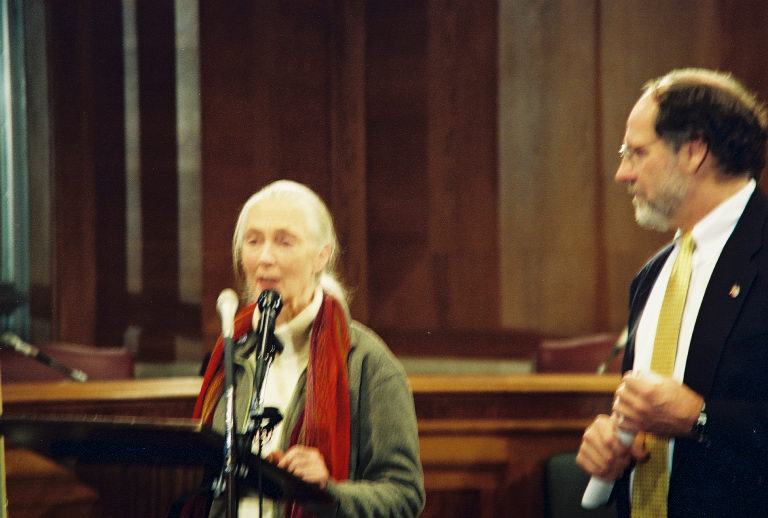
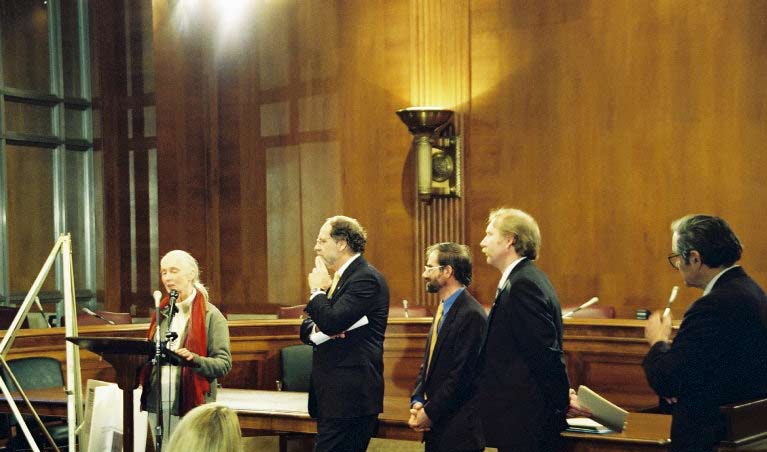
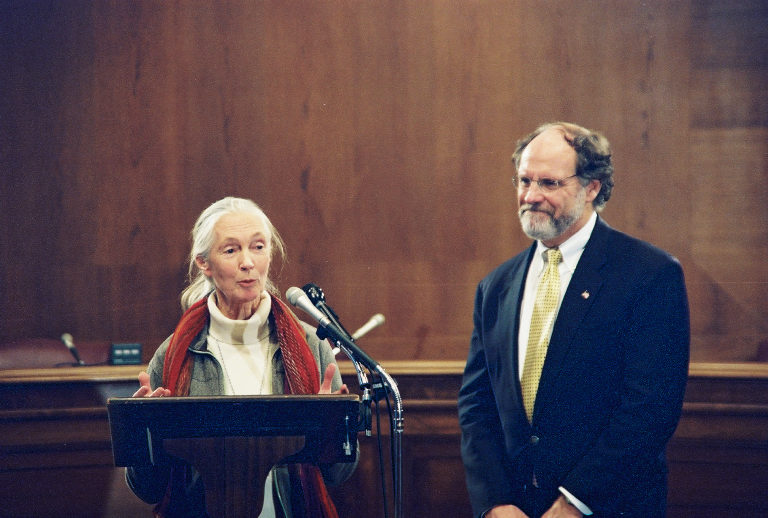
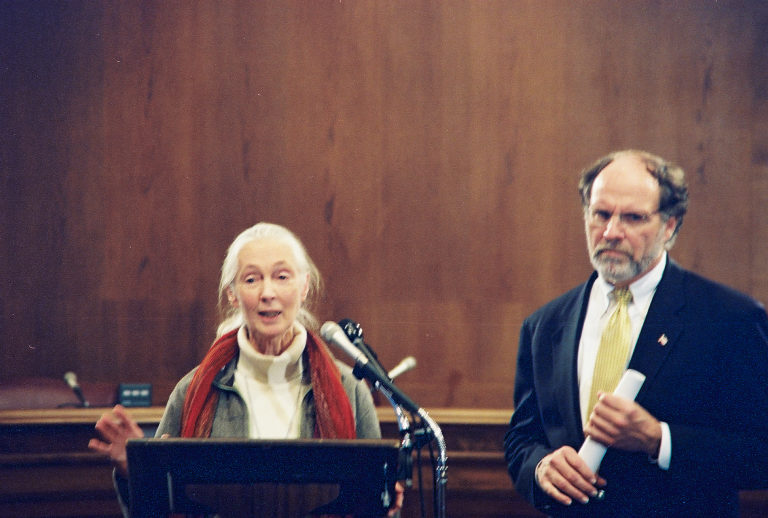
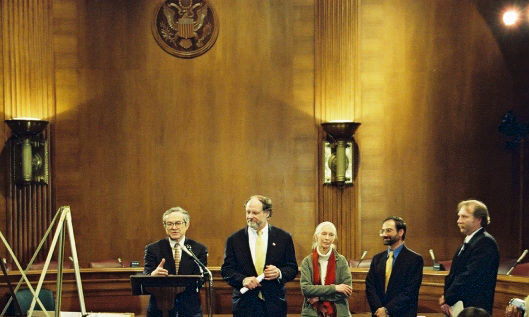
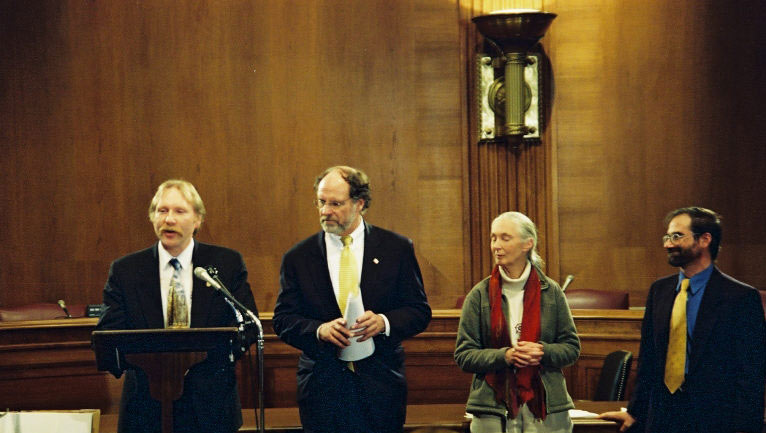
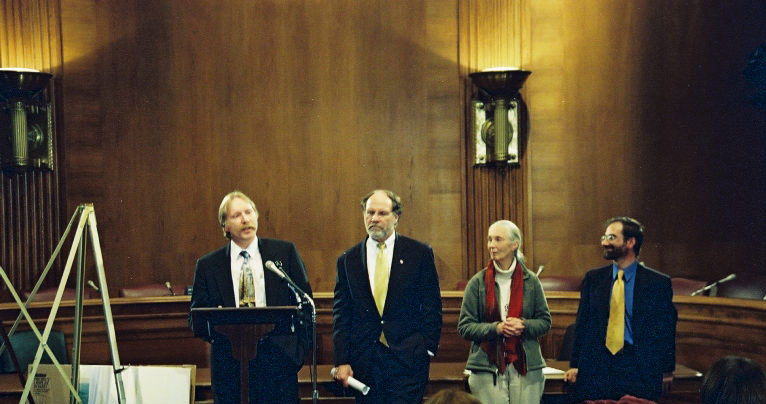
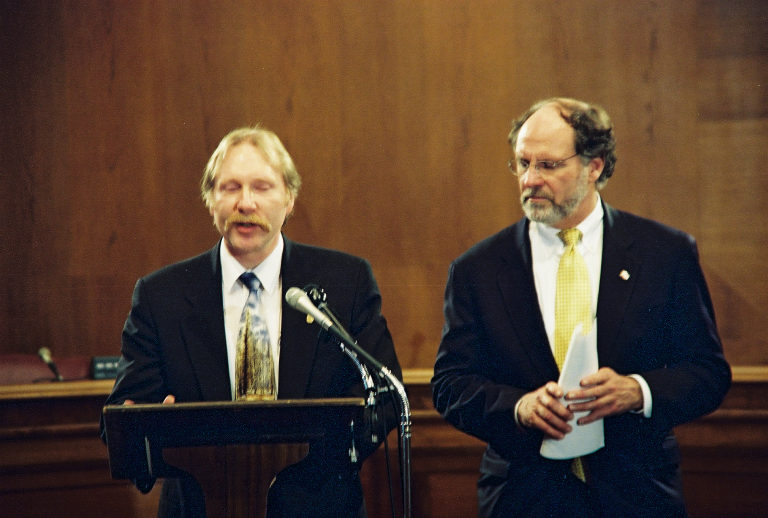
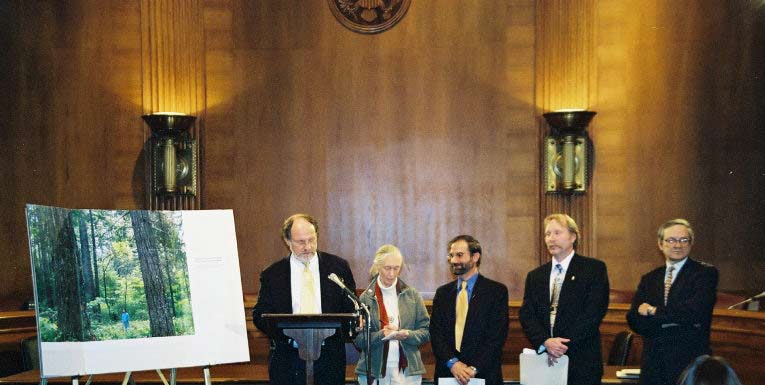
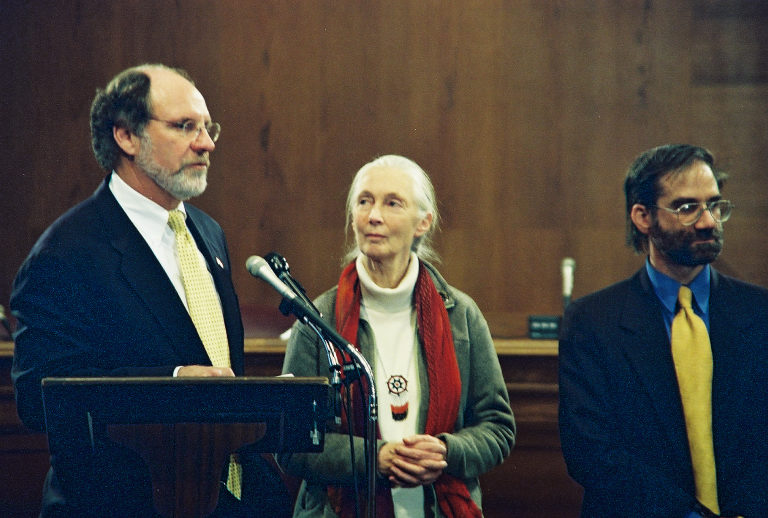
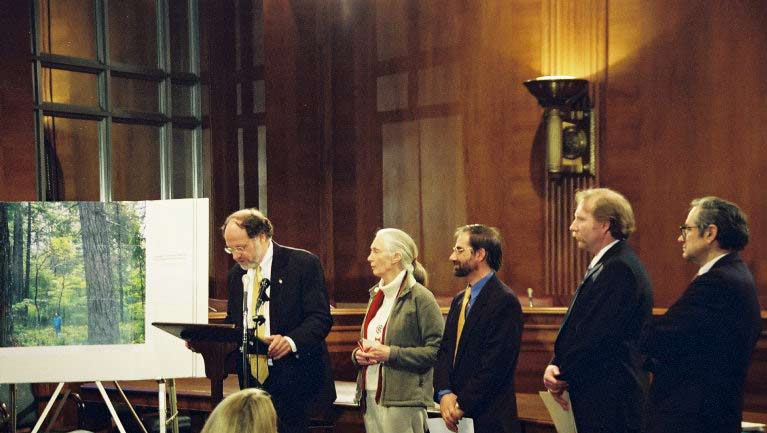
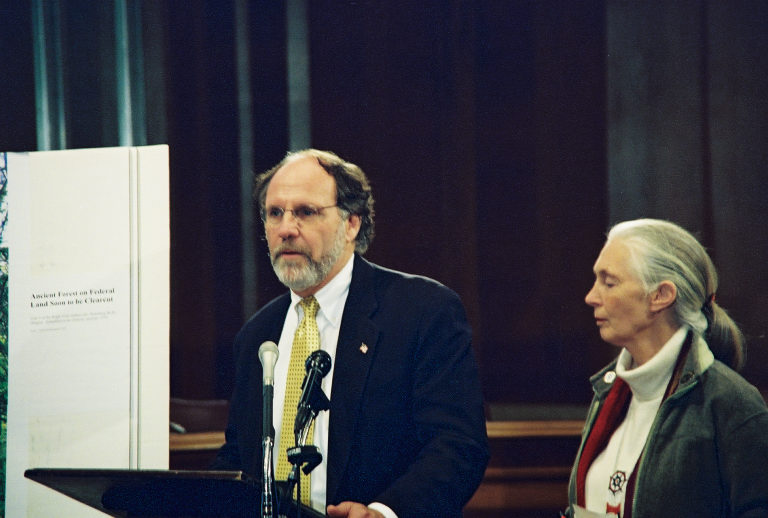
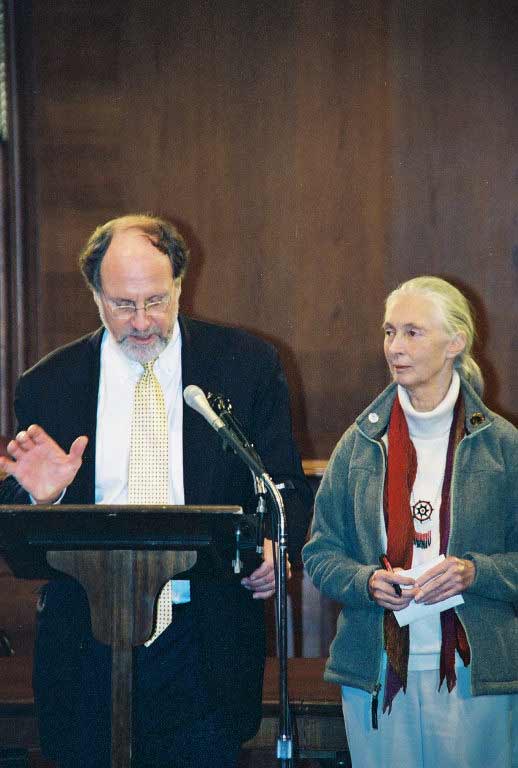
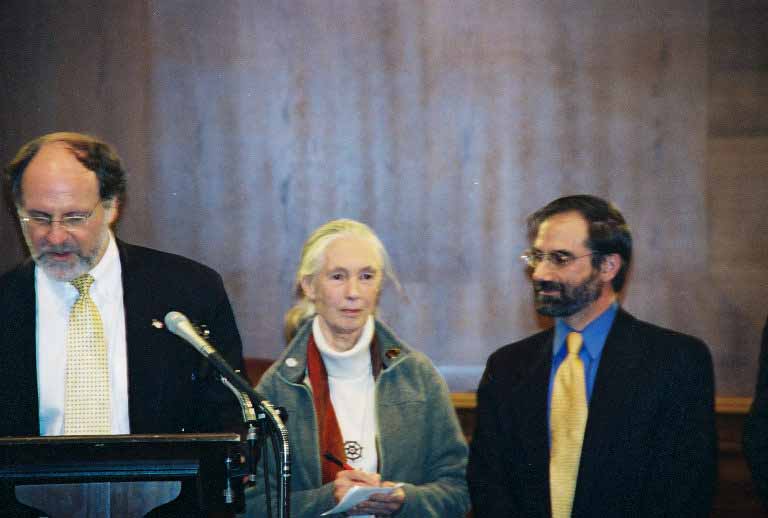
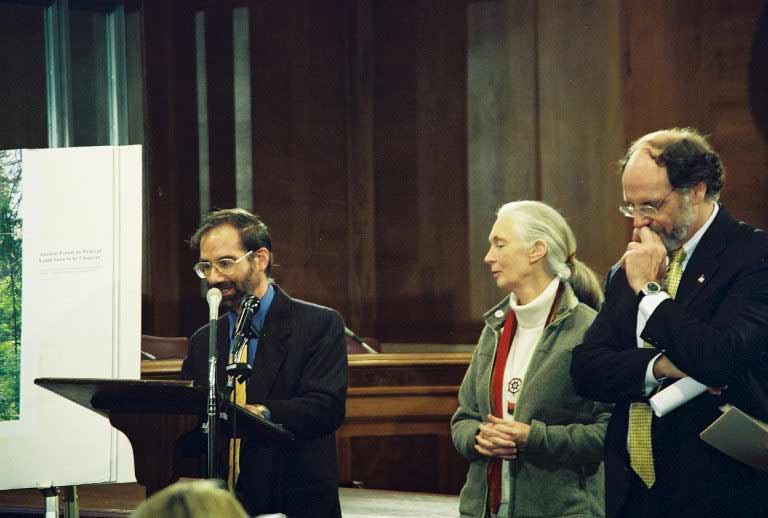
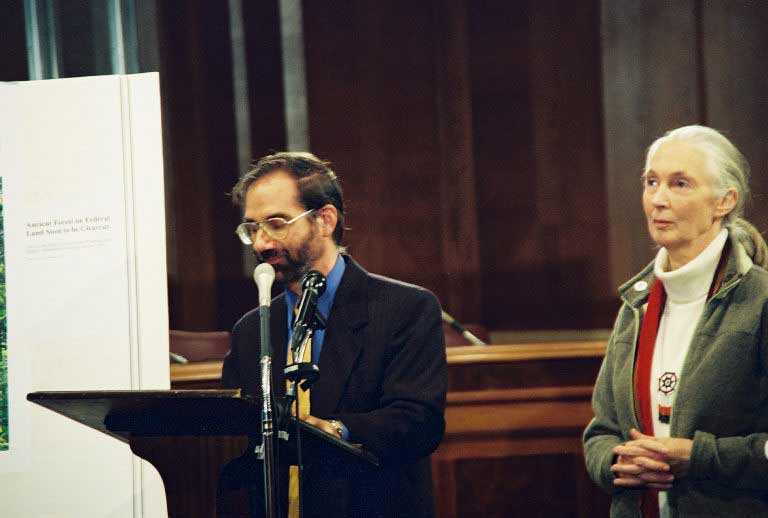
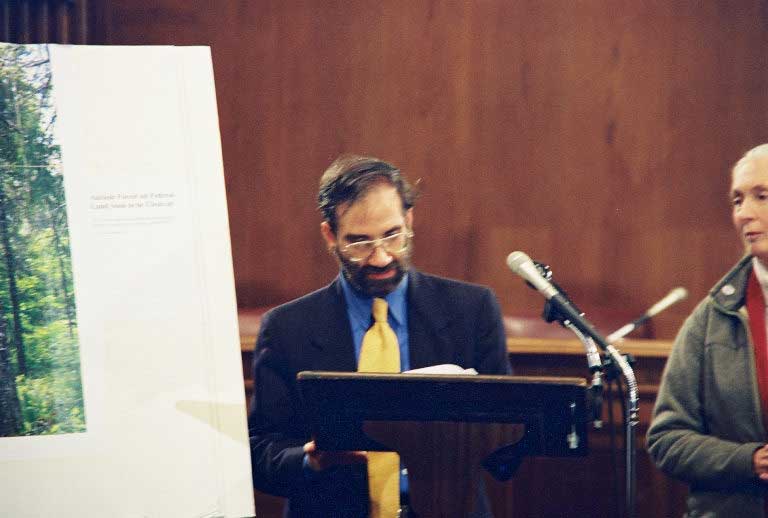
On April 1, 2003, Senator
Jon Corzine hosted a press conference in the U.S. Senate Dirksen Office
Building in Washington, D.C., to announce that he would be the new Senate
sponsor of the Act to Save America's Forests.
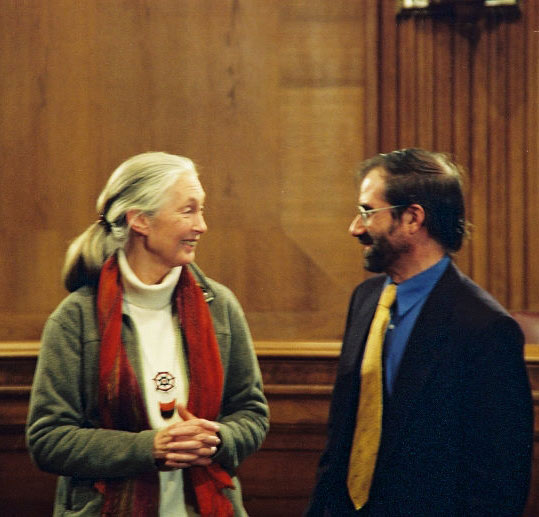
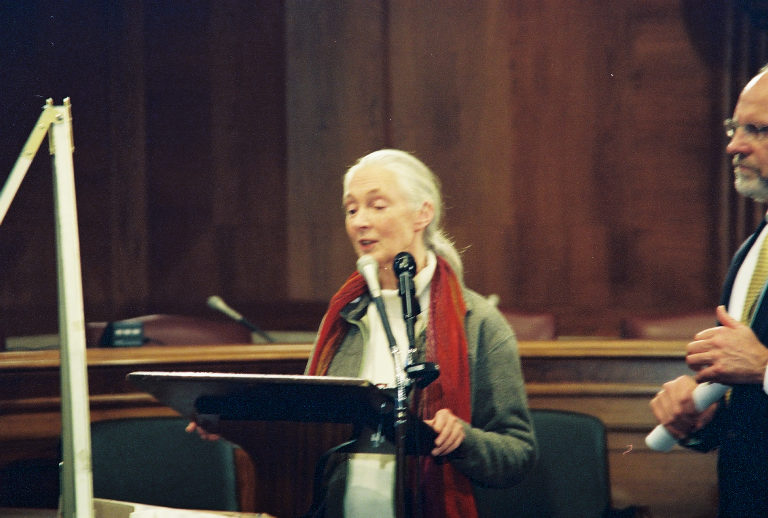
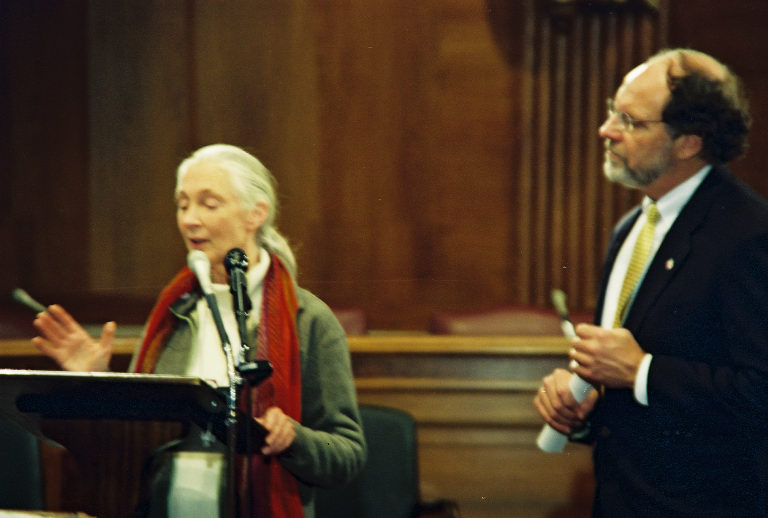
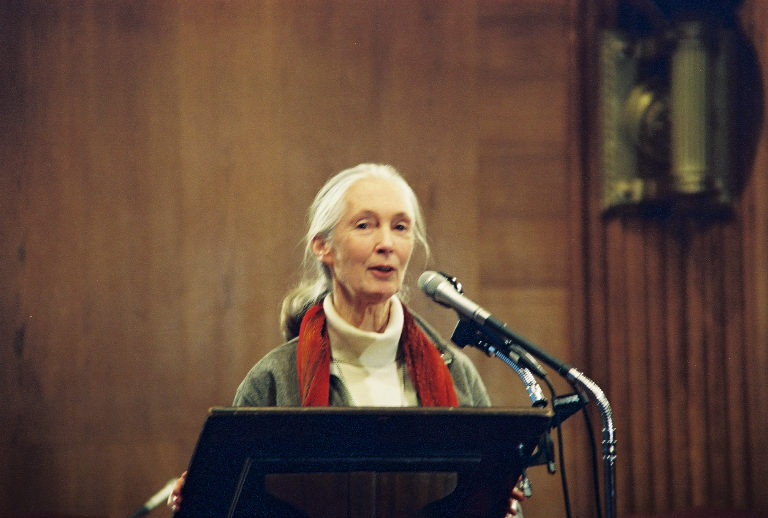
Joining him was Dr. Jane Goodall,
world famous biologist, and pioneering chimpanzee researcher. Dr. Goodall
is founder of the Jane Goodall Institute, which carries out many programs
to protect chimpanzees and other primates around the world, and the
forests where they live. Dr. Goodall made a speech about the problems
of world-wide deforestation, including at the famous Gombe Forest in
Africa, where Dr. Goodall lived for many years studying the chimpanzees.
Dr. Goodall praised the Act to
Save America's Forests for protecting the last remaining Ancient
Forests and roadless forests, and for promoting ecologically sustainable
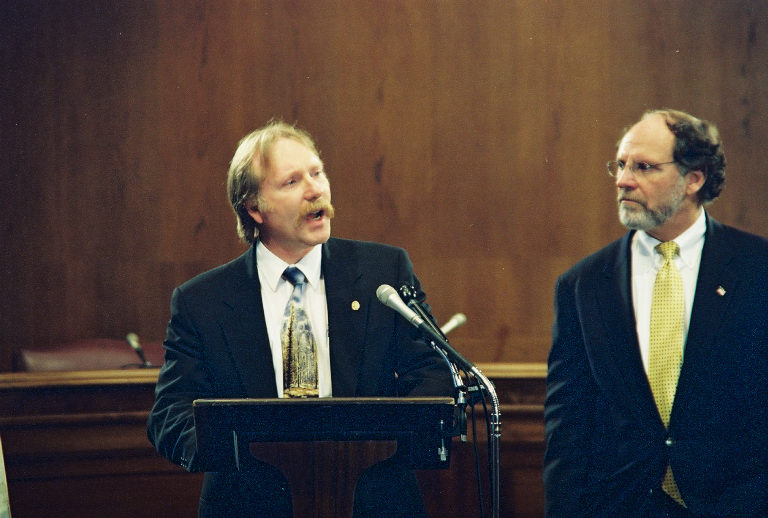
logging. Also speaking on behalf of
the Act were Carl Ross, Dennis Schvejda, and Brent Blackwelder.
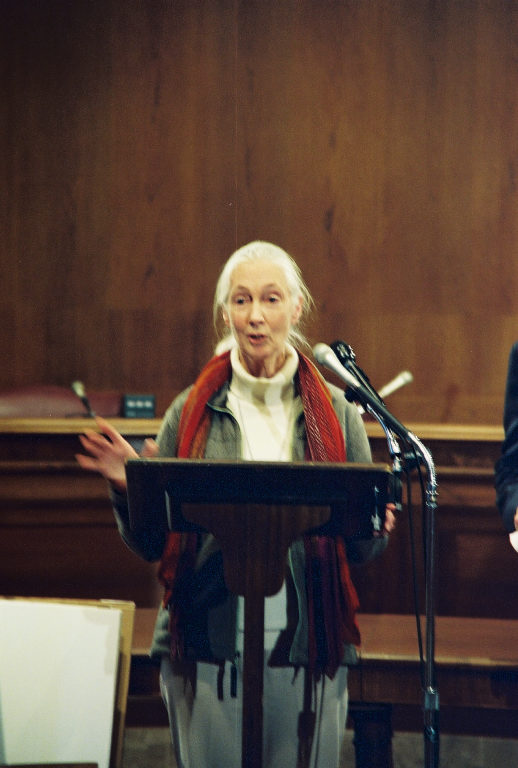
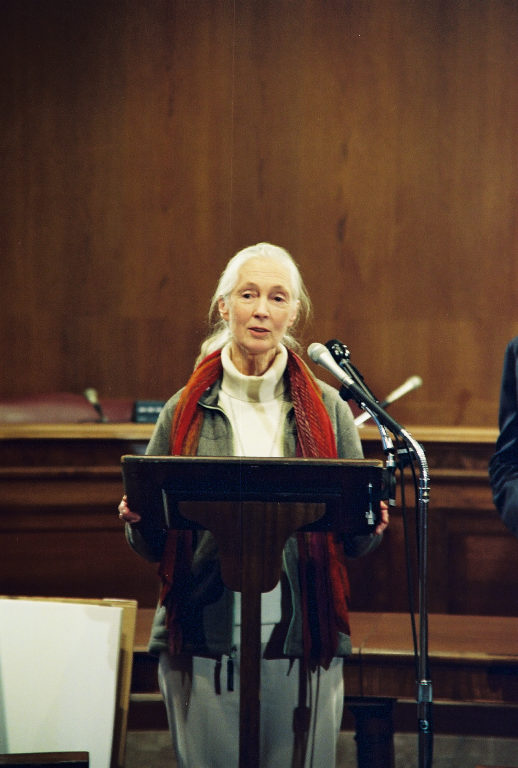
Following the press conference, Dr. Goodall
gave a 20 minute lecture about her work and the Jane Goodall Institute
projects, including Roots and Shoots, whose mission is to foster respect
and compassion for all living things, to promote understanding of all
cultures and beliefs, and to inspire each individual to take action
and make the world a better place for animals, the environment, and
the human community.
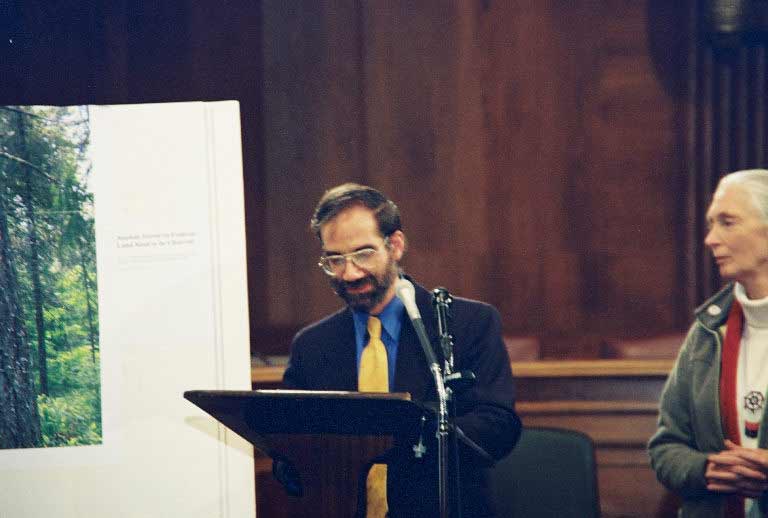
Great. Thank you all for joining us, good afternoon,
and I'm truly pleased to be here with colleagues who feel very concerned
about the environment and conservation of our forests.
We
are all honored to be here with Dr. Goodall, who is both famous but also
powerful with regard to everything she has done in her life to promote
the protection of our environment and the encouragement of others to work
in those areas. We really are pleased that you could join us. And this
legislative process is probably different from a scientific one you are
accustomed to but it is important that we actually merge those efforts
so that we can move thoughtfully in how we move forward with our environment.
Also,
I'm pleased to be joined by Carl Ross who is the founder and Director
of Save America's Forests. Carl, thank you for being here. Brent Blackwelder
is President of Friends of the Earth and served as an environmental advocate
in the nation's capital, it says over 30 years. That's a long and important
service to our nation. Then, Dennis Schvejda who is from New Jersey Sierra
Club, and it's good that you would join as well to be here today.
We're
really talking about a simple message. There's 191 million acres in our
National Forests, rainforests from Alaska to the cypress groves and swamps
of Florida. We think they should be managed for more than a single value,
that is, their timber value. They ought to be managed for wildlife, water,
and recreational purposes. They ought to be thoughtfully managed in a
scientific context. I don't think you would find any of us particularly
happy with how we are actually dealing with our forests these days and
timber production, and our practices have often been more destructive
than they've been constructive or conservative. There's plenty of clearcut
forest cutting. We have examples that we'll show around that are really
indicative of what I think is devastatingly bad forest management principles.
And we have often gone into clearcutting procedures and then in turn gone
to single species replacements or tree farms as the next step afterwards.
A lot of us find that hard to put together with a view of proper forest
management or what is good for the diversity or biodiversity of our Earth.
The
result of this is that, in fact, we have just a sliver left of our ancient
forests in the United States and we feel strongly that we need to do everything
we can to protect that as we go forward. And as you know there is a big
debate about roadless areas in this country and that is very much a kissing
cousin to the issue we're talking about with ancient forests, and it's
one that needs to be addressed.
What
we're asking for is a balanced approach. Make sure that we think about
more than one use, and to think about putting together sustainable and
scientifically sound practices with regard to our logging. We're not saying
no logging. What we are trying to say is let's do this on a basis that
is sustainable over a period of time, and thoughtfully put together and
that will do more than just log but protect but protect wildlife, enable
recreation, and produce clean water and all the other results that I think
people are interested in.
The
Administration, on the other hand, I think, is bent on performing or seeking
another mission. Frankly, they've sought to undermine the Clinton Administration's
Roadless Rule which has protected 58.5 million acres of National Forests
from logging. Despite more than 1.6 million public comments in support
of the Rule, the Administration announced in February that it's going
to amend the rule, so that our Roadless Areas will remain in jeopardy
as we go forward. And it's really troubling, actually, how aggressive
the Administration has been in turning it's back on policies and procedures
that at least moved us a little bit down the road toward more thoughtful
management of our forests.
I
think all of you are aware of the February announcement with regard to
the Tongass National Forest; the opening up of 9 million of wilderness
protected forests to logging. It's just indicative of where the mindset
is and there is a lot for us to do to push back and to resist the direction
we're taking let alone take the positive steps that we'll be talking about
today.
I
almost have a hard time saying that the Administration's Healthy Forests
Initiatives is something that's constructive. It basically opens up 20
million acres to logging and thinning, and will waive environmental laws,
public comment, administrative procedures, and judicial review in the
process. I don't think that's how you get to healthy forests, but language
sometimes covers up the sins of reality.
Simply
put, the Administration is turning its back on something that is very,
very vital, not only for this generation but for future generations as
we go forward. This bill, The
Act to Save America's Forests, is designed to strike a
balance between those four competing areas, it prohibits logging and roadbuilding
in the last remaining ancient forests and roadless areas. But in other
areas of National Forests, ecologically compatible selection of logging
would be allowed, but clearcutting and monoculture tree farms would be
banned. The legislation requires the Forest Service and other agencies
to protect and restore the native biodiversity of the area, the National
Forests.
I'm
proud the bill has widespread support in the environmental and scientific
community. When it comes to the environment, we tend to throw the term
"sound science" around. It makes nice speeches but doesn't necessarily
relate to the reality. I think this bill actually does. We have over 600
leading scientists, including Dr. Goodall and Dr. Wilson of Harvard and
a whole host of other folks obviously pushing this concept as we go forward.
I feel very good about the intellectual and scientific backdrop that supports
this effort. Congresswoman Maloney who was going to join us today, is
not here. She's going to be working to push this process …(sound
of cell phone ringing)...push this bill in the House and we'll be hearing
from her as time goes on with regard to this. I just want to say thank
you to all of these folks who committed their time and effort to really
try to raise the level of the debate we have with regard to this foresting
issue.
I
think we can make a difference over a period of time. Right now we have
got to fight the direction the Administration is taking, but we need
positive alternatives laid on the table.
That's what we're doing
in this act to save the forests. I feel very good about where we are.
Hopefully we can through the fullness of time and good arguments and
great science we will be able to defend a sustainable effort with regard
to our forests in this country.
I
think I'll now turn it over to Mr. Ross, and have him make his presentation.
Thank you.
Carl Ross: Thank you.
Senator Corzine: By the way, that phone call
was from the White House. They don't like your idea.
it prohibits logging and roadbuilding in the last remaining ancient forests and roadless areas. But in other areas of National Forests, ecologically compatible selection of logging would be allowed, but clearcutting and monoculture tree farms would be banned. The legislation requires the Forest Service and other agencies to protect and restore the native biodiversity of the National Forests."
Carl Ross: This
gathering here today on behalf of forest protection, for the Act
to Save America's Forests, is an important step forward
in the long effort to protect our living forests. Great strides have
been made in the past, and we Americans are proud of our vast open spaces,
and the national parks and places that we have protected, that are as
much a part of the American character and nation as freedom and liberty.
But
there is unfinished business, and time is running out. Most of our original
forest ecosystems have long ago been cut down. Yet, a few percent still
remain, though they are unprotected, on our federal lands. Our national
forests contain the last Ancient Forests, proud survivors of an era
that lasted millions of years, when giant forests ruled the earth, unchallenged.
The relentless march of civilization used up the Ancient Forests, the
wood, the animals, the land, and now we are at the last moment we will
have the opportunity to save these remaining Ancient ecosystems from
our chainsaws.
After
a century of clearcuts, our national forests are badly fragmented. Oceans
of mud are eroding from the roads and clearcuts into pristine rivers.
Fish can't spawn, birds can't nest, animals cannot roam. Many species
are headed towards extinction. There are landscapes of clearcut lands
where there were once endless forests.
The
Act to Save America's Forests is an historic piece of legislation that
would achieve forest protection on a national scale. The Act is a culmination
of science, popular will, and common sense. The Act says the national
forests should be treated in the way that Americans want their public
forests managed. Americans want the last remaining Ancient Forests and
wild, roadless areas protected from logging and roadbuilding. The Act
would accomplish these clearly, in national forests across the country.
The public opposes clearcutting on public lands, and the Act would end
this senseless and destructive management regime, sparing our national
forests from further needless degradation of clearcutting.
And
the public wants the native species of plants and animals on our public
lands protected. If our wild species cannot be safe on our public lands,
then where can they survive? Our national forests should be natural
forests. Indeed, the national forests are the largest spaces left in
America, the last places that large, intact complex, natural forest
ecosystems can survive. We should not be paying tax dollars for either
clearcuts, nor unnatural tree farms on our federal lands. The Act says
that the native species should protected and restored.
Scientists
have strongly endorsed the Act because it is based on the principles
of conservation biology. These three basic directives of the Act, protecting
Ancient Forests, roadless areas and other core forest areas, allowing
limited amounts of ecologically compatible logging in buffer areas,
while preventing clearcutting, and protecting native species, is a comprehensive
plan for managing our national forests. Indeed, a plan of this scale
is the only hope, as modern science has informed us that small patches,
or biological islands of forests cannot long survive. We need to make
our national forests whole once again.
It
should be self-evident to us all, now, that we need to live on this
fragile planet in harmony with nature, not destroy it.
If
we pass the Act into law, a hundred years from now, the millions of
acres of clearcuts and scarred areas will heal over, and the national
forests will be a continuous carpet of towering green forests, such
as existed centuries ago. They will once more be home to all the native
species, who can continue their life and evolutionary place on earth.
In
both the Senate and the House of Representatives, the Act
to Save America's Forests has made great legislative progress.
It is time to push forward, end decades of interminable wrangling, and
give strong, clear, and permanent legislative protection to the last
remaining public wild forests.
As
in so many things, the world is watching America, looking to us for
direction. If we turn over a new leaf, and give this comprehensive balanced
protection to our national forests, then we will set an example of large
scale forest protection for the entire world to follow.
STREAM VIDEO
;
Carl Ross
"If our wild species cannot be safe on our public lands, then where can they survive?
Our national forests should be natural forests."
Carl Ross
Carl Ross
Carl Ross
"It should be self-evident to us all, now, that we need to live on this fragile planet in harmony with nature, not destroy it."
Photos of press conference: Jay Jennings
Carl Ross:
And
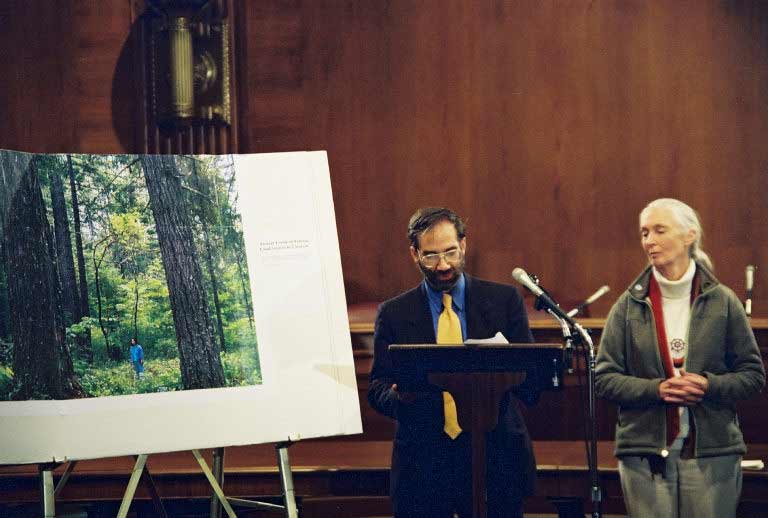
I'll just take a moment to point out these exhibits.
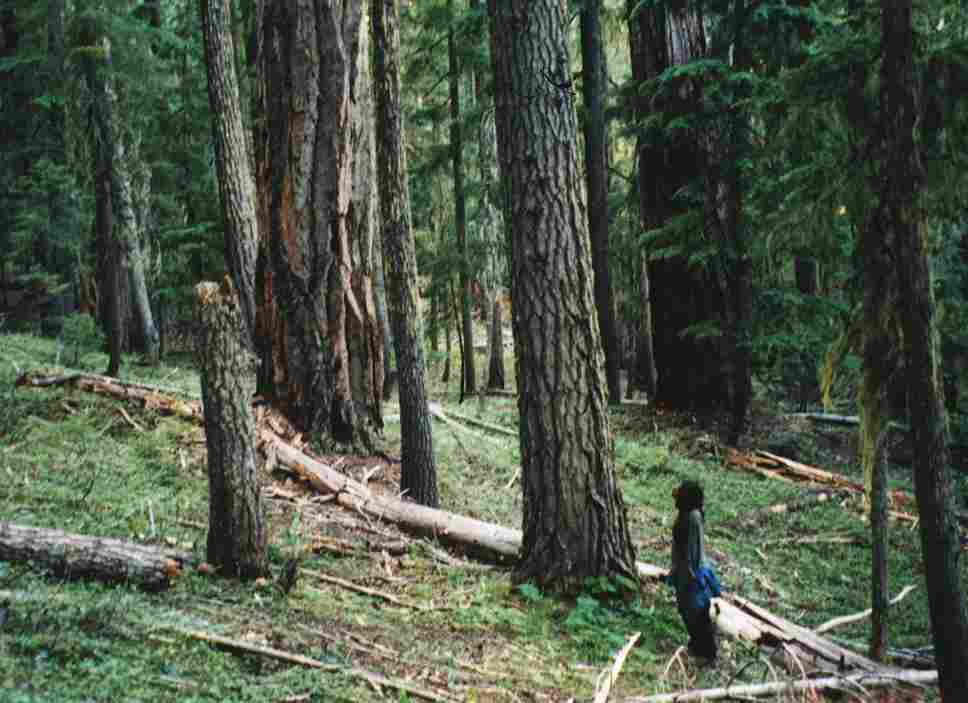
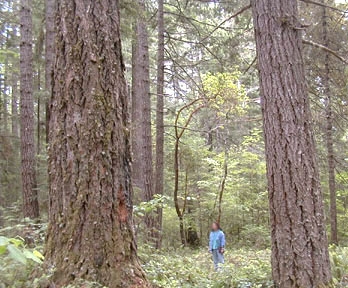
1. Obviously this is an
ancient forest on federal land. It was cut recently.
Photo: Francis Eatherington, 1999
Ancient Forest
on Federal Land
Soon to be Clearcut
Unit 5 of the Right View timber sale,
Roseburg BLM, Oregon.
Scheduled to be clearcut, Summer of 1999.
Carl Ross
2.
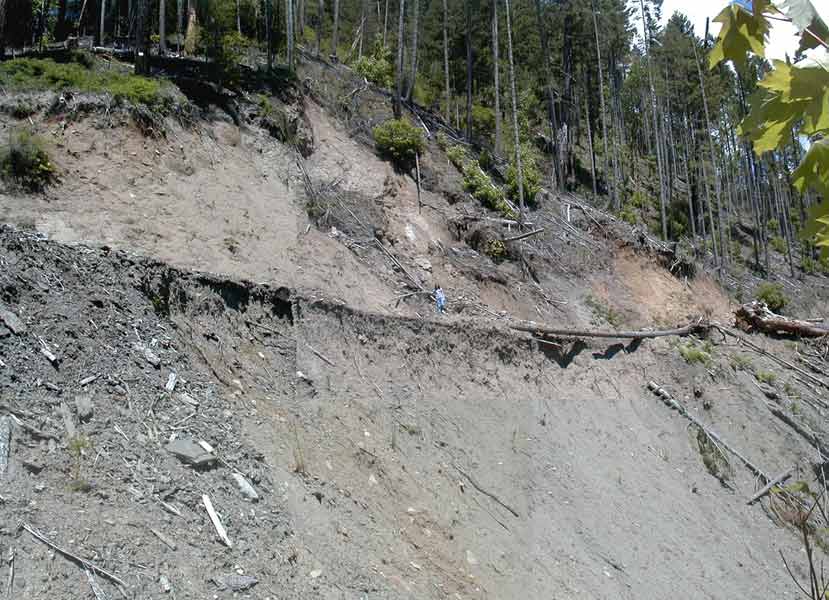
This is a landslide on federal land that was clearcut. And the Bureau
of Land Management, a federal land agency which this bill would cover
— it knew in its documents that this area was prone to landslides,
that it had loose soil, and that if they cut it, it said in their own
documents, it could have a landslide! And yet they cut it anyway! And
the landslide happened inevitably.
\
Photo: Francis Eatherington
Recent Clearcut of Ancient Forest
on Federal Lands Disastrous landslide caused by road and
clearcut.
Units
2 and 3, Right View timber sale, Roseburg BLM, Oregon. Sold 1996 and
logged under the rules of the Northwest Forest Plan, which was claimed
would protect the Ancient Forests, but does not!
The BLM knew that his
forest was located on unstable soil, and logging would cause a landslide,
but they went ahead anyway, and the landslide occurred!
That's a person
in a blue jacket in the center of the photo.
Carl Ross
3.
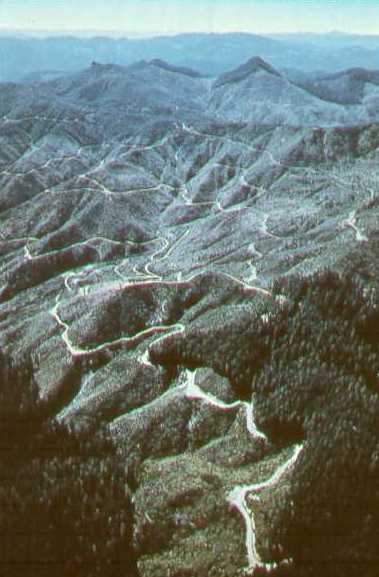
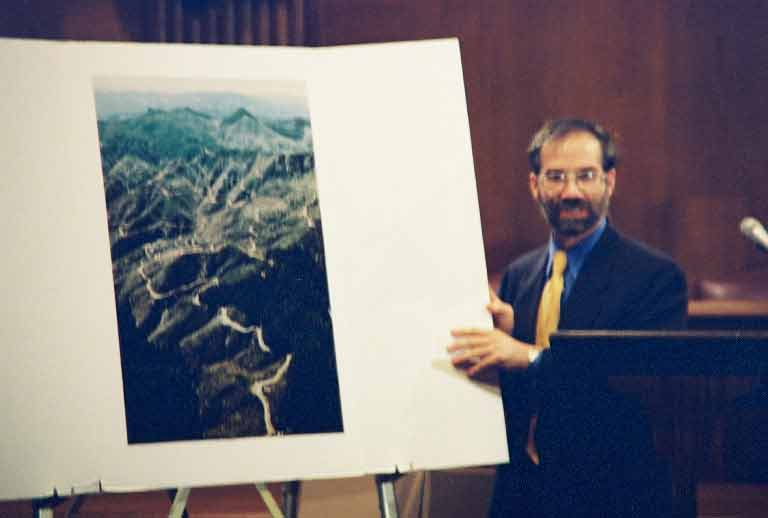
Here is a picture of one of the countless ones you could take on federal
land. It shows the 400,000 miles of timber roads that have been built
in our National Forests at tremendous expense, primarily to cut the trees
down. Now the 400,000 miles, to give a concept, is ten times more miles
than in our Interstate Highway System. And these roads are eroding terribly
and causing even more damage in conjunction with the clearcuts. So this
is damaged land that needs corps of citizens to repair the damage, take
out many of these unneeded roads and let the scarred land heal over.
Carl Ross
Carl Ross
------- Ross
4.
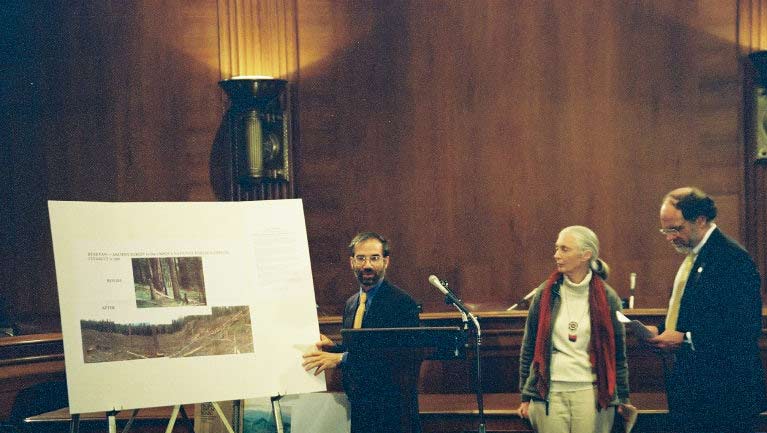
This last exhibit shows a before and after of the very same spot. This was
taken in the year 2000 and it was cut. And so this what we're losing, the
last few percent of ancient forests and the animals that live there. It
took thousands of years for this particular forest to grow and become a
climax forest. It's really important that we save these last areas and put
our National Forests back into wholeness again.
BEFORE ...
(Click on picture to see detailed enlargement of
photo)
BEFORE ...
BEAR PAW — ANCIENT FOREST in
the UMPQUA NATIONAL FOREST in OREGON
This rare Ancient Forest was in a roadless
area,
with trees 7 centuries old!!!
AFTER!
BEAR PAW — The exact
same spot as the picture above!!! After a clearcut in the year 2000
destroyed this rare, centuries old forest! (Click on picture to see detailed enlargement
of photo)
Senator Jon Corzine:
Carl, thank you very much.
Great presentation and pictures are better than 1000 words as they say.
Dr. Goodall speaks with Carl Ross
Senator
Jon
Corzine
Senator Jon Corzine:
It
really is an honor to have me introduce our next guest and speaker. She's
had an extraordinary career that began in the 60s and her world famous
work in the study of chimpanzees, but you know, she's taken her scientific
work and used it as a means to provide for advocacy and education of others.
There really are very few people who speak with the authority that Dr.
Goodall does with regard to the kind of issues with regard to sustainability
of our forests and all of our environment as we go forward than she does
and it's really a pleasure to have you speak out. Thank you.
Thank you.
I always feel compelled to try and lend my voice to any issue which is
about protecting the environment, but especially the forests because for
me the forest is a kind of home. It's rather a sacred place. It's filled
with the most amazing creatures, and when I'm in the forest I feel almost
as if I'm in a cathedral. All around the world forests are disappearing.
We all know that. We hear these figures about the destruction of the last
old growth forests, the opening up of the last great rainforests in the
Congo Basin in the Amazon and in Indonesia and all these other places.
And
as we've already heard, when forests are clearcut the environmental damage
is horrendous. You lose your biodiversity. You cause tremendous soil erosion,
particularly on the steeper areas.
STREAM VIDEO
;
Dr. Jane Goodall
And
as Carl was explaining to me, these National Forests that haven't yet been
logged, are the ones that are on the steeper places because the lowland
forests were easier to log in the early days. So you get the terrible soil
erosion and in some countries this has led to incredible environmental disasters
such as in China where clearcutting in the forests in the Highlands led
not only to flooding but to the creation of a dustbowl. And actually was
the one thing that caused the government in China to finally admit that
they did have some serious environmental problems on their hands. So the
clearcutting of the forests in China has led to the opening up for other
kinds of environmental efforts in China.
Dr. Jane Goodall
And
very often as I'm travelling around talking about the destruction of the
forests leading to the extinction of the chimpanzees and the other great
apes, I find that in the United States people are 100% behind anything they
can do to stop the destruction of these last great rainforests in great
ape habitat. But there are still a number of Americans who don't realize
that the exact same rape of the last forests is going on in their country.
The same could be said for Europe.
"But there are still a number of Americans who don't realize that the exact same rape of the last forests is going on in their country."
Dr. Jane Goodall
When
we talk about sustainable logging, when we talk about having a balance between
the interests of the loggers and the interests of Senators and Congressmen
who are seeking for work opportunities for people in their districts, and
then we think on the other hand of the concerns of citizens who want to
protect the forests and the concerns of scientists who realize what the
loss of biodiversity means, there are people who can't ever come to any
kind of compromise, that can benefit everybody.
That's
not true.
Dr. Jane Goodall
First
of all I visited an amazing forest called Wildwood in British Columbia which
has been sustainably logged for 48 years by an amazing man Merv Wilkinson.
He is still providing a sustainable living to many loggers around this area.
There are more animal species now than when he bought this land with a partner
to save it from development. And when you walk into it, to return to the
image I started with, you feel you're going into a cathedral. And so we
have this Act to Save
America's Forests, with its beautiful balance. Let's protect the core
areas, let's protect those areas that still are like cathedrals to those
of us who love them, that are protecting biodiversity, that will give our
children and their children some sense of the wonder which once covered
so much of the Earth's surface and is now represented by such small places,
but nevertheless wonderful places. And the Act will also protect the surrounding
buffer areas, where sustainable logging can be carried on, but no clearcutting
will be allowed. This built-in measure will help restore some of the forest
that's been damaged or lost around these core areas.
"And so this Act to Save America's Forests, with its beautiful balance, let's protect the core areas, let's protect those areas that still are like cathedrals to those of us who love them, that are protecting biodiversity, that will give our children and their children some sense of the wonder which once covered so much of the Earth's surface."
Dr. Jane Goodall
This is an Act
which—not if it passes but when it passes,
(one day it will pass, because it must) — that is going to do so
much for the legacy that this generation will leave to the generations
to come. And I would say that I'm spending a huge amount of effort on
developing our Jane Goodall Institute's Roots and Shoots Program, which
involves young people in activities to make the world a better place for
animals, people, and the environment. Because what's the use of my trying
to save chimpanzees and someone in America trying to save black bears,
if at the same time their habitat is destroyed and the young people are
not learning to be better stewards than we have been.
Dr. Jane Goodall
So
I'll stand up for the passing of this Act
now and I will again if I'm asked to in the future, because I believe passionately
it's the right thing to do and I applaud everyone who is supporting it.
Let's get together and get enough public opinion behind us to make sure
that it does pass, because it must be.
"This
is an Act which,—not
if it passes but when
it passes, (one day it will because it must)—that is going
to do so much for the legacy that this generation will leave to
the generations to come.
So I'll stand up for the passing of this Act now and I will again if I'm asked to in the future, because I believe passionately it's the right thing to do."
I'm
Brent Blackwelder, President of Friends of the Earth, United States. I want
to just say a word why I think this bill
is not only extraordinarily important for the United States, but also crucial
as we look at forests all over the planet.
Friends
of the Earth United States is part of Friends of the Earth International,
with member groups in 70 countries, we have the largest democratically
global advocacy network for the environment. What our member groups say
to us is you in the United States are preaching, save the tropical rainforests,
but when you look at your own history of safeguarding your very own public
lands, with your great forests, it's a tragedy, it's a disgrace. I'm here
today to salute Senator Corzine in the effort to practice what we preach,
and to put good stewardship in place, and also to salute the effort that
Carl Ross and Save America's Forests has put together in assembling this
legislation.
There
has been a long history of efforts and concerns about forests going back
to Teddy Roosevelt, and the establishment of the national forests. c
And,
more recently, former Senator Wyche Fowler took an extraordinary interest
in protecting forests. We have been trying to encourage all of these efforts,
and its really good that you have assumed the leadership role. It's something
we absolutely have to do in the United States. If we set the example here
others will follow.
STREAM VIDEO
;
"This bill (the Act to Save America's Forests) is not only extraordinarily important for the United States, but also crucial as we look at forests all over the planet"
Good
afternoon. My name is Dennis Schvejda, I'm Conservation Director of the
New Jersey chapter of the Sierra Club. I'm very thankful to be here today
to speak out on America's Forests. Now let's be clear, America's forests
are in very deep trouble. They have been in trouble since the Pilgrims
landed on this soil. Since that time, America's forests have literally
been clearcut from sea to sea.
There
are a few areas that are left, most of them are on public lands. A few
areas have grown back, but let's not be fooled. You can leave this room,
the Senate building, you can go out to some forests in Maryland or Virginia
or anywhere else, you are looking at second growth forests. You are looking
at forests that are a pale, pale, shadow of what they should have been.
STREAM VIDEO
;
Dennis
Schvejda
Believe
it or not, you would have sycamore trees, maybe not that tall, but sycamore
trees would get up to 20 or 25 foot in diameter. They would hollow out and
the pioneers would live in them as a temporary shelter. You would have trees
that easily would be beyond 10 feet in diameter. You will never see those
trees here in the East again. Never.
Now,
the west, we're fortunate. We have a few pieces left. You have seen these
pictures of Oregon. I have driven through Oregon. These pictures are real.
Mile after mile after mile of steep hillside with the trees ripped off
and the dirt sliding down. That's there, it's a shame.
"America's forests have literally been clearcut from sea to sea.
Believe
it or not, you would have sycamore trees...that would get up to
20 or 25 foot in diameter. ..
You
will never see those trees here in the East again. Never."
Dennis
Schvejda
I
have been to the redwoods, most of the redwoods are gone. A few percent
that are left. Most of them are protected, but not all. I know people that
are not environmentalists, they have been to Muir Woods, they have been
to the Redwoods, they became changed people when you walk through there.
You talk about a cathedral, that is a cathedral, you can't walk though those
types of woods and not be a changed person.
I
have been to the northern Rockies, I have hiked the peaks there with Rick
Bass who is trying to save the Yaak. You climb those mountains and you
look. You can look into Idaho, you can look into Canada and what do you
see, you see patches of clearcuts.
I
have been over to the Tongass. Now the Tongass is our largest National
Forest. Basically it almost as big as the entire East Coast. I was fortunate
again to, it is a place where the sea and the forest meet. It's a place
that is perhaps the most biologically rich in this continent.
Dennis
Schvejda
I
remember we were going up a fiord. It's very narrow, very steep, there was
a water fall on one side and a mirror image on the other side, and Orcas
were coming out, there was a large Orca with tall fin, a couple of babies
this big, boinking out of the water. It was incredible! In the distance
was a tall peak. Underneath that peak was sort of an alluvial plain of two
rivers coming out.
And
there were plenty of seals there, they were hiding from these Orcas. Now
those flat areas are the areas that are going to be logged by the Tongass,
in the Tongass.
It's
a beautiful spot
I
also went to a spot in the Tongass where they destroyed the land. They
blasted out hills, they blasted out roads, we're not talking about cutting,
we're talking about actual blasting, and they blasted holes in the ground.
And what is even more criminal is that fact that there were trees piled
up, now this is old. These trees had been cut for a while, there was a
rusting hulk of a log-loading type of device, it was all rusted up, so
we knew that this had been there for quite a while. There were piles of
trees taller than this room that had been left to rot. To add insult to
injury! Unbelievable!
Dennis
Schvejda
Sierra
Club was founded by John Muir. And so many of our great environmental organizations
were founded by, you know, people that dedicated their lives. And the people
that are here today, they say you stand of the shoulders of giants, and
we certainly do. And I would like honor John Muir by reading a paragraph
that probably most of you know, but it is very appropriate to today.
"Any
fool can destroy trees, they cannot run away, and if they could, they
would still be destroyed. Chased and hunted down as long as fun or a
dollar could be got out of their bark hides. Branching horns, or magnificent
bole backbones, few that fell trees plant them, nor would planting avail
much towards getting back anything like the noble primeval forests.
It took more than 3000 years to make some of these western woods, trees
that are still standing in perfect strength and beauty, waving and singing
in the mighty forests of the Sierra. Through all the wonderful eventful
centuries, God has cared for these trees, saved them from drought, disease,
avalanches, and a thousand straining leveling tempests and floods. But
he cannot save them from fools; only Uncle Sam can do that."
Dennis
Schvejda
And
that is really why we are here today. We are here because it is a federal
answer.
And
our champion, is our distinguished Senator from New Jersey, Jon Corzine.
" Through all the wonderful eventful centuries, God has cared for these trees, saved them from drought, disease, avalanches, and a thousand straining leveling tempests and floods.
But he cannot save them from fools; only Uncle Sam can do that."
Well, big surprise. I had no idea that I was going to have the pleasure
of speaking to you all. But, as I think the message that the Jane Goodall
Institute has to give is a very important one, I'm absolutely delighted
that you're all here, and will take full advantage of the opportunity.
Most
of you know me because of the work that we've been doing with the chimpanzees
in Gombe National Park. So, because I like to take the voice of the chimpanzee
into all kinds of unlikely places, and I've never taken it into this particular
building before, I will give you a chimpanzee greeting (starting low and
slow, and getting faster, louder and higher in pitch, and trailing off
at the end)
"So, it's no wonder that I love the forests. In fact, my love affair with forests began when I was eleven years old "
Dr. Jane Goodall
So,
it's no wonder that I love the forests. In fact, my love affair with forests
began when I was eleven years old and I read the books of Edgar Rice Burroughs
about Tarzan of the Apes, describing these jungles in Africa filled with,
actually now I look back on it, really ferocious beasts. It didn't quite
seem like it then. I just fell in love with Tarzan and wanted to be there
with him swinging in the vines and being close up to all these amazing animals.
So,
eventually, I was able to save up, get out there, meet the late Louis Leakey
and have this incredible opportunity to go and learn about our closest living
relatives, the chimpanzees.
We
had no idea, back then in 1960, quite how close chimpanzees were to us.
Biologically, we didn't have the faintest idea; behaviorally, nobody knew
anything about them in the wild at all. We now know that we differ in
our genetic structure from chimpanzees by only just over one percent;
that in this regard, chimpanzees are more like us than they are like gorillas
even. And then we can go on talking about similarities in the composition
of the blood. So you could get a blood transfusion from a chimp, again,
not from a gorilla. And the immune system so like ours that that's why
chimpanzees have been imprisoned in laboratory cells of five foot by five
foot, because some people have thought they would be useful for learning
about otherwise uniquely human diseases. They can catch all our known
infectious diseases, or be infected with them.
Dr. Jane Goodall
And
then the brain. This is where it gets more interesting. The brain of a chimpanzee
is more like ours than that of any other living creature, and amazingly
similar in its anatomy. So, it shouldn't be surprising that therefore they
show so many intellectual abilities that we used to think absolutely unique
to ourselves. So that, the observations that we've made of wild chimpanzees
showing intelligence in day to day life, such as using and making tools
to solve food getting problems, or other problems, using rocks and sticks
as weapons, having a really complex system of communication, which includes
touch, posture and gesture. Having sophisticated cooperation, especially
seen when they're hunting for colobus. And I should mention that in their
nonverbal communication, we see some of these really uncanny similarities
to us. So that if you saw two chimpanzees and you knew nothing about chimpanzees,
and they came from opposite sides of a forest and they flung their arms
around each other and kissed and patted one another on the back, you'd have
a pretty good feeling that they were good friends, because that's what we
do and it means the same thing, and we could go on like that.
And
research that's been done on chimpanzee intellect in some captive situations,
non-invasive situations, throws even more light on some of these similarities
in intellectual performance. They can learn more than five hundred of
the signs used by deaf people - American sign language. And they can use
them with each other as well as with the people who've been teaching them.
In fact, one young chimp was able to show fifty-six of these signs in
their complete correct context when he was eight years old, having never
been taught by a human, but having been interacting with four signing
chimpanzees. It's just one example of the way that chimpanzees can pass
behaviors from one generation to the next through observation, imitation
and practice, therefore showing quite clearly that they have a form of
primitive culture. So, here we are, and I could talk for a very long time
about ways in which chimpanzees are like us.
"One young chimp was able to show fifty-six of these signs in their complete correct context when he was eight years old, having never been taught by a human, but having been interacting with four signing chimpanzees."
Dr. Jane Goodall
So, when I tell you how fascinating it is to be out there
in the forest with them, to get to know all their vivid and unique personalities,
to see the long term bonds between mothers and their offspring and follow
these through generations, to get to know some of the vivid personalities...
When
I tell you, as you heard, that for me, being in a forest is rather like
being in a cathedral, and one of the most wonderful places I can be. Why
am I not there? Why am I instead traveling around the world three hundred
days a year, talking to groups of people like yourselves, big public lectures,
schools? Why am I not in Gombe, where so much of my heart is?
The
reason I'm not in Gombe is that it suddenly became apparent, when we had
a conference bringing together chimpanzee researchers from all over Africa,
and also some people who got secretly, film video in some of the medical
research labs ... it became very obvious chimpanzees need help and they
need help badly. And the forest homes in which they live need help badly.
And it was like a shock for me. I went into that conference as a scientist
ready to come out and continue analyzing the data. This was in 1986. And
I came out having viewed slide after slide of the destruction of the forests
across Africa; the chimpanzees caught in snares; chimpanzees being hunted
for food; mothers shot, also hunted for the live animal trade; came out
with pictures of these chimpanzee prisoners in these tiny five foot by
five foot cells, and I knew that I could no longer go and sit where my
heart wanted to be, because I had to try and do what I could to help.
And
that set me on this traveling around the world, which has got wider and
wider. It began in 1986 and since that day, I haven't spent more than
three weeks consecutively in any one place, because, whereas I began in
Africa, going to the chimp range countries, talking to governments and
trying to work with some of the local people to protect some of these
forests and raise their level of awareness, which meant introducing some
educational tools, you know. I suddenly began to realize that the destruction
of the forests, although part of it was due to human population growth
and desperately poor people having no other way to support themselves
than clearcutting to grow crops - at the same time, so much of the really
shocking devastation was caused by the unsustainable demands of the developed
world, in particular in the Congo Basin, the great European logging companies.
And, although they're practicing so-called sustainable logging, they're
making roads deep into the heart of the last rainforests of the Congo
Basin, opening up the forested areas to settlement, people cutting down
the trees to grow their crops - setting their snares in which chimps can
get caught by hand or foot. They can't get the wire snare off, so they
may die or at least lose a hand or a foot.
And
then getting to learn more about this bush meat trade, as it's called,
where the hunters now have access along the logging roads. They can ride
the logging trucks. They shoot everything from elephants to monkeys to
birds and bats. They smoke it. Now, for the first time, they have transport.
They load it on the trucks and it's taken to the towns. And much of it
is exported from one African country to another, and even to exotic restaurants
in the developed world. This is not a trade that's designed to feed starving
people. By in large, it's the commercial exploitation which is unsustainable.
And also you have logging camps of two to three thousand people deep in
the forest or around the edge who weren't there before, and they want
animal protein. And so, the pygmies, who've lived in harmony with their
forest world for hundreds and hundreds of years are being given money
and guns and ammunition to go and shoot for the logging camps, and that's
not sustainable either. None of this is sustainable.
" When
I tell you, as you heard, that for me, being in a forest is rather
like being in a cathedral, and one of the most wonderful places
I can be.
Dr. Jane Goodall
The good news in these issues is that there are some
quite substantial initiatives to try and do something about the bush meat
trade in the Congo Basin. And the initiative which brings me often to this
part of the world is that initiative from the American Department of State
that was announced by Secretary of State, Colin Powell at the Earth Summit
in Johannesburg. It was one of the good things that he had to announce,
since mostly he was trying to explain why the President of this country
wasn't at the Earth Summit. So, this initiative is about sixty million dollars
over the next three years for this Congo Basin Initiative, more or less
matched by the European Union, and with some of the big conservation groups
like World Wide Life Conservation and International Wildlife Conservation
Society coming in. The initiative of the United Nations grasped the Great
Ape Survival Plan which is being pushed by UNEP, a coalition of NGO's on
the ground all working to try and find a way to save the last of the chimpanzees
and the last of the forests in the Great Congo Basin, which itself is acting
like the lungs for the whole of that part of Africa.
The
Jane Goodall Institute is very small, but we do have expertise on the
ground. We do have our own small Congo Basin Project which is particularly
working with groups of women. They know that none of this hunting for
bush meat is sustainable. They have to feed their families and so, working
to create cooperatives among the women so that they will push for licensing
- that's one way of trying to control this absolutely crazy hunting that's
going on. But we also have to work with partners in the private sector,
the logging companies, work with World Bank, and as I say with all the
other NGO's and all their different initiatives down on the ground.
"Why am I not in Gombe, where so much of my heart is?
The reason I'm not in Gombe is that it suddenly became apparent, ... it became very obvious chimpanzees need help and they need help badly.
And the forest homes in which they live need help badly. "
Dr. Jane Goodall
Even
closer to home, when I arrived at Gombe National Park in 1960, you could
go for miles along the shores of Lake Tanganyika, and this beautiful forest
would come rolling down along the waters of Lake Tanganyika - crystal clear
waters in those days. And Lake Tanganyika is about three hundred miles long
- a few small villages, the odd town, but by an large, chimpanzee habitat
right along the lake. And then if you climbed up to the peak of the hills
of the Rift escarpment, because this is the western branch of the Great
Rift Valley, and you looked eastward, away from the lake, away from Congo
- forests stretching as far as you could see.
Today,
outside the thirty square miles, that's all it is, thirty square miles
of Gombe National Park, which looks the same as it did in 1960. But outside,
all the trees have gone! It looks like some of the pictures that were
demonstrated here. And there is terrible soil erosion, because this is
steep, rocky ground; the precious topsoil washed down into the lake and
people begin struggling to survive. The normal population growth added
to by massive influxes of refugees during the 70's from Burundi, and then
over the lake from Democratic Republic of Congo when it was Zaire. And
these refugees are still pouring in. And the land can't possibly support
this number of people, and there's nowhere for them to go. They're too
poor to buy food from elsewhere.
So
how can we even think of saving these precious chimpanzees known around
the world -- literally, around the world. (A young woman in South Korea,
the first time I ever went there came up and asked me how Fifi was.) So,
this led to the Jane Goodall Institute starting a program called TACARE
or Take Care. And this is working in 33 villages around the park and up
and down the lake shore to improve the lives of the people, to offer suggestions
about the kind of trees that could be grown in tree nurseries, developing
wood lots and also providing primary health care, conservation education,
AIDS education, family planning information.
And
we've opened up nine micro credit banks based on the Grameen Bank, so
that women can take control of some of the environmentally sustainable
development programs and start to improve their own lives, and this is
desperately important because it's been shown all around the world that
as women's education increases, so family size drops. And that is desperately
important in this part of Tanzania. And the people in the villages, both
sexes, are welcoming any information that we can provide them about family
planning. That was a surprise, but it turns out to be the truth.
"when
I arrived at Gombe National Park in 1960, you could go for miles
along the shores of Lake Tanganyika, and this beautiful forest would
come rolling down along the waters of Lake Tanganyika - crystal
clear waters in those days.
"Today, outside ... of Gombe National Park ... all the trees have gone!
It looks like some of the pictures that were demonstrated here.
And there is terrible soil erosion, because this is steep, rocky ground; the precious topsoil washed down into the lake and people beginn struggling to survive."
Dr. Jane Goodall
So,
one of the programs that we have in our Take Care program, and which began
in Tanzania about eleven years ago, is a program for youth called "Roots
and Shoots." Roots make a firm foundation. Shoots seem tiny, but to
reach the sun can break through a brick wall. And we see the brick wall
as all the problems that we humans have laid on this planet - the environmental
problems of all kinds, the social problems, problems of violence, war, terrorism.
It's
a message of hope for the youth of today which in so many cases I find
has lost hope. When they look at the mess that we, the older generations
have made, how we've compromised their future. I met so many thoughtful
students who have given up hope. And this is a program designed to give
hope to the hopeless. The main message is that hundreds and thousands
around the world can break through these brick walls and make the world
a better place. The most important message we give to each individual
is that every individual indeed makes a difference, has a role to play
- that you can't live through a day without impacting the world around
you. And we all have a choice as to what sort of impact we want to make.
And every group tackles three kinds of hands on projects to make the world
around them a better place, for animals, including domestic animals; for
their own human community and for the environment that we all share.
The
kind of projects the kids choose, well that will depend first of all how
old are they, and they range from pre-school through university. In fact,
"Roots and Shoots" has seeded itself in some strange, mysterious
way that I haven't yet understood in five United States prisons and a
number of senior citizen complexes in different parts of the world. The
kind of projects that the children do therefore, obviously depends which
age category they are in, also to some extent their ethnic group and their
religion, but which country are they in -because what began with eighteen
high school students in Dar Es Salam in Tanzania, is now in seventy countries
around the world with close to five thousand active groups, and we can't
get a handle on how many kids that involves, but it's thousands and thousands,
tens of thousands of young people. It is changing lives. It's changing
lives in the inner cities; it's changing lives in hopeless rural areas.
"A program for youth called "Roots and Shoots."
It's
a message of hope for the youth of today, which in so many cases
I find has lost hope."
Dr. Jane Goodall
And it is my way of providing hope for the future, because I have three
little grandchildren. And when I look into their eyes and I think how we've
damaged this planet since I was their age, in just the years of my life,
it makes me feel so ashamed. And that's why the sort of initiative that
I came here for today - the Act to Save America's Forests, is one of the
important things that we can get our young "Roots and Shoots"
groups to take action in - to write letters, to go into the forests, to
feel the beauty of the forests so that as they grow up they'll be more and
more passionate about protecting them and think of more and more innovative
ways of protecting them.
So
I think that as we move forward in this very difficult time when the Administration
is undermining so many of the environmental protections put in place by
previous Administrations, that it's a time for linking hands, for joining
efforts, for working together. We must work together for common goals,
even if we may be moving in slightly different directions to get there;
we want to try and present a united front. And I think there are some
things that all environmental and animal protection and human rights people
can work together for, and that's making sure that the beauty that we
still know today, although it's going fast, is still there for our grandchildren.
So,
that's what "Roots and Shoots" is all about. And that's why
I'm happy to have the opportunity to talk to you. And if you have any
questions, if we have time, I'm happy to try to answer them. I should
introduce, sitting in the front here is Fred Thompson, the Jane Goodall
Institute President. And sitting next to him is Nona Gandelman who's the
Jane Goodall Institute Director of Communications. So, we are actually
able to communicate with you brilliantly now. We have a wonderful web
site, which is www.janegoodall.org. I think you could all perhaps remember
that. And it is fantastic. We had a demonstration to our board just yesterday.
In fact, I've come directly from the board meeting now and these things
happen. I'm running around giving lectures, and I come back and I see
this amazing web site and I think, Wow. That's quite something.
Dr. Jane Goodall
Fred Thompson:
If anyone would like to join the Institute and help us make a difference,
just give me your business card.
Dr. Jane Goodall: Can we join on line now?
Yes. You can join on line as well. There are some people who seem reluctant
to do anything except on line.
Carl Ross: How many countries, and which countries
have you been to lately?
Dr. Jane Goodall: Well, since Christmas, since
the twelfth of January, I've been to India, Bangladesh, Tanzania, different
parts of England for lectures, Ecuador, Mexico and about twelve cities
in the United States. It's fairly busy.
Question from audience: In your "Roots
and Shoots" program are most of the projects terrestrial? Do you
do any marine?
Dr. Jane Goodall: "Roots and Shoots"
projects are amazing because, you see, it's the kids who think of them.
We have projects in absolutely every sphere you can imagine, and they
range from learning about marine life or life in the forest or whatever
environment is around you, or even in another part of the world, to taking
active steps to try and do something to protect it - clearing up rivers,
re-introducing fish, cleaning up beaches, recycling and imaginatively
creating artifacts out of waste. I don't know if any of you, you just
might have seen.... if any of you saw any of the demonstrations for peace.
"Roots and Shoots" has had an imaginative link up with Puppet
Farm, and they've created, I think in America, there's a flock of twenty
five giant peace doves. So, if you see any photos with these giant peace
doves, and you can see them on our web site, they're absolutely amazing.
They're flown by three people, and they're all made out of basically recycled
stuff. And they're making an impact. I mean people notice them. They stretch
from here to the wall; they're up on poles.
So,
the groups are working. We had one group in Tanzania that put on a sports
day for the disabled which involved an audience of six thousand people.
So, depending on what their interests are, whether it's social, or whether
it's environmental or whether it's humanitarian for animals, - you know,
lots of working with dogs in shelters and cats and rescuing a dog from
a dumpster, which brought the whole community together. The veterinarian
volunteered his services; and the people were bringing in pet food to
the extent that they could supply the local shelter for years to come;
people offering to look after the dog. So, you know, many, many projects.
Question from audience: When you talk about
the logging that goes on, the road building and the bush meat industry
that occurs, is there effort with some of the countries to try to find
a sustainable effort? These are countries that obviously are looking for
hard cash to survive also. Are there efforts to work with them?
Dr. Jane Goodall: Absolutely. This Congo Basin
Initiative indeed is working with local NGO's, with private sector, with
big international donors, but definitely with the local people, local
government authorities, the local people living there and central government.
And it's mostly the European companies are mostly practicing clearcutting,
some much better than others. There are Asian companies beginning to come
in, and they, unfortunately, are clearcutting.
But
there are such signs of hope, like President Bongo of Gabon was given
a feeling for the tropical forest. Well, he didn't actually go there,
but he was steeped in slides and film by Dr. Michael Fay, who did the
two thousand mile walk across the Congo Basin, and Nick Nichols, a photographer
with National Geographic. And President Bongo has created thirteen new
forest parks, which were announced at the Johannesburg Earth Summit, as
part of the constitution of the country, and in many of those cases, it's
involved taking contracts or concessions away from logging companies.
So, you know, there is hope everywhere, in all these areas.
It's
just, there's a lot of corruption. Find me a country where the government
isn't liable to be corrupt. It's very difficult, especially, we're learning
more and more, in the developed world, or parts of the developed world.
And so you get corruption, but you also get the fact that many people
are making a lot of money out of it. So we have to find alternative protein
sources for the local people, for the logging camps. We have to educate
the elite that this practice of going out and just bringing stuff from
the forests is not sustainable. But at the moment they're prepared to
pay more for that than a piece of chicken or goat, because that isn't
traditional for them.
So,
there's a lot of education to be done, "Roots and Shoots" to
be started up. And then, alternative ways of making a living for the hunters
and the middle men, the people who are now making a lot of money out of
this huge trade. I mean, every time I hear the figures, I forget them
because they're so much bigger than I thought they were, whether in terms
of revenue that comes into the country or just the sheer tonnage of bush
meat that's coming out of the forest each day.
"Roots
and Shoots" projects are amazing because, you see, it's the
kids who think of them.
Dr. Jane Goodall
OK, we've got two more questions. He says I have to go. There's one there
and one there.
Question from audience: What are some of the
things you can get students in this country to do to help preserve the
rainforests?
Dr. Jane Goodall: Well, I think that one really
important thing that students can do is really to join "Roots and
Shoots." And I'm saying that, not because I would anyway, I'm saying
that because many other groups are actually there already—we have
Girl Scouts, Boy Scouts, we have environmental groups of different organizations,
and they maintain their identity, but they join the umbrella. That means
we've got a groundswell of people. That gives a young person support.
That's one important thing. The other thing is then perhaps we can work
out more and more ways of taking young people into the forests—certainly
taking films into the schools, helping them to understand that it isn't
a question of black and white. The goal isn't no logging at all. It's
to totally protect some of these amazing areas of old forest, old growth,
and then, have some kind of properly conducted, sustainable logging which
can truly be sustainable if you do it right—because I've been in
forests where it's been done. It usually isn't done right, but it can
be. So that the youth understands that it isn't a question of saying no
to all logging, because then they get confused, because people say; "Well
then all the loggers lose their jobs." So they need to learn it's
the sustainable, best practices that will give the loggers their jobs
on into the future. If you clearcut it all now, the jobs are going to
be gone anyway, but this never seems to get across.
So,
learning about the problem, going to see it - those are the two main things;
and we can try and do both through "Roots and Shoots."
There
was a question over here somewhere. Has it gone away? OK. Well then, that's
it.
"The goal isn't no logging at all.
It's to totally protect some of these amazing areas of old forest, old growth, and then, have some kind of properly conducted, sustainable logging which can truly be sustainable if you do it right...
So that the youth understands that it isn't a question of saying no to all logging, because then they get confused, because people say; "well then all the loggers lose their jobs." So they need to learn it's the sustainable, best practices that will give the loggers their jobs on into the future. If you clearcut it all now, the jobs are going to be gone anyway."
 \
\